AI Search Is Changing Google, and the Web Built Around It
Search is becoming less about choosing a link and more about getting an answer. Google, Microsoft, OpenAI and Perplexity are pushing AI deeper into search, creating new opportunities for users while forcing publishers to rethink how they earn visibility and traffic.
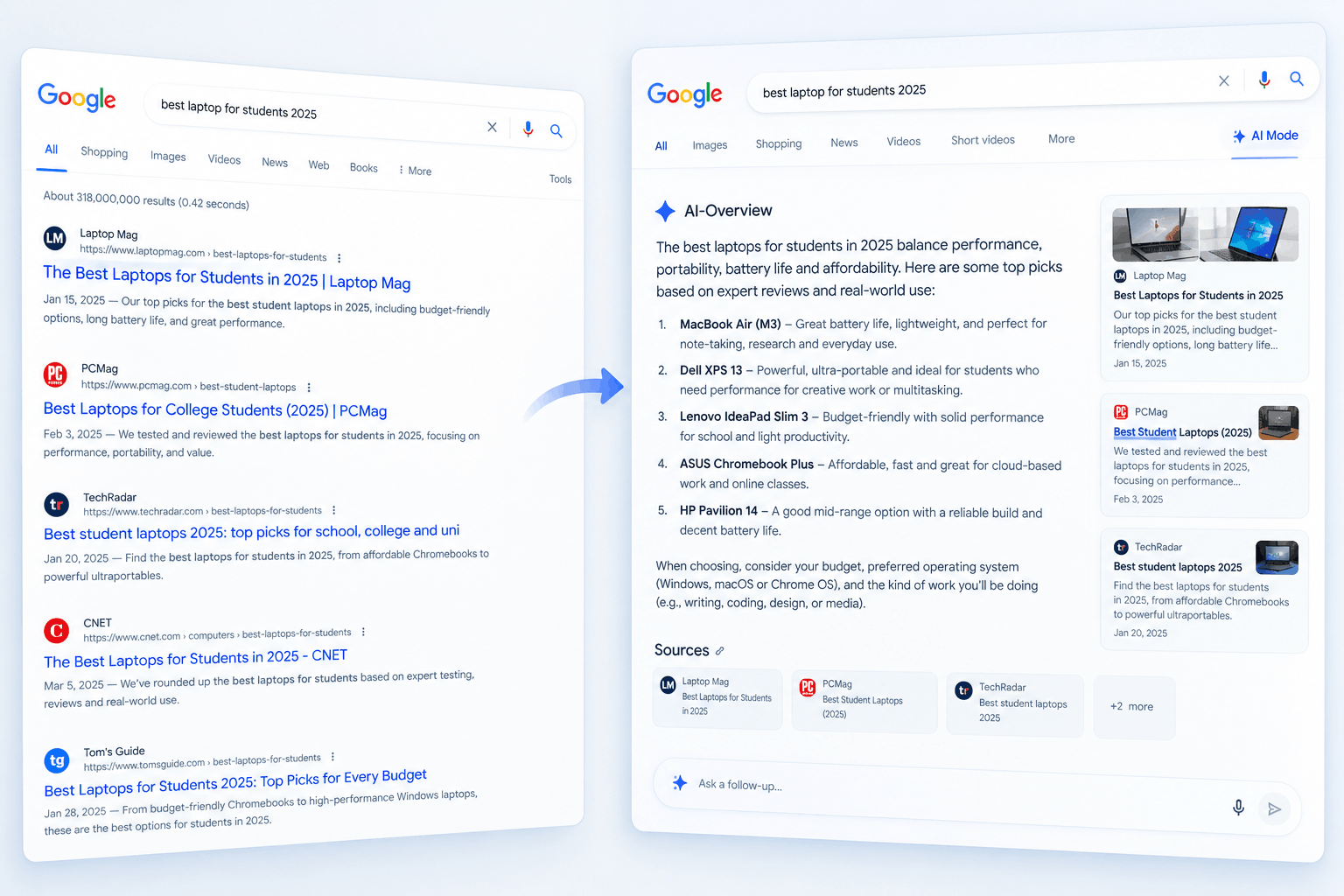
For more than two decades, Google Search trained people to expect a familiar routine: type a question, scan a page of links, open several websites and assemble the answer yourself.
That routine is changing.
Google now places AI-generated summaries directly inside Search. Microsoft offers conversational answers through Bing's Copilot Search. OpenAI has turned ChatGPT into a web-search destination, while Perplexity has built its product around AI-generated answers with cited sources.
The result is a gradual shift from searching for information to asking an AI system to find, interpret and summarize it.
Deloitte expects that shift to become significant in 2026. Its prediction is that daily use of generative AI embedded inside search will be about three times as common as daily use of standalone generative AI applications. Deloitte estimates that 29% of adults in developed markets will encounter an AI-generated search summary on a daily basis, compared with 10% using standalone generative AI apps each day.
That distinction matters because it puts AI in front of people who may never deliberately open an AI chatbot.
Google is turning Search into an AI conversation
Google is perhaps the clearest example of where search is heading.
Its AI Overviews feature places an AI-generated response above traditional search results for queries where Google determines a summary could be useful. The company has subsequently expanded AI Mode, allowing users to ask follow-up questions and continue a conversation without starting a new search.
In January 2026, Google said Gemini 3 had become the default model for AI Overviews globally and that users could move directly from an AI Overview into a conversational AI Mode experience.
By May, Google said AI Mode had surpassed one billion monthly active users globally and that queries in AI Mode had more than doubled each quarter since launch.
Google's direction is therefore broader than simply putting a chatbot at the top of a results page.
The company is trying to make the search box itself more conversational.
Users can ask longer questions, ask follow-ups, upload images and explore topics without repeatedly returning to a conventional list of links. Google says AI Mode queries are, on average, twice as long as traditional Search queries.
At Google I/O 2026, the company also described a more unified Search experience in which users can move from an AI Overview to AI Mode while continuing to access links to websites.
Bing and ChatGPT are following a similar path
Google is not alone.
Microsoft's Copilot Search in Bing generates summarized answers, cites sources and suggests follow-up topics. Microsoft describes it as an experience designed to provide more context and deeper exploration than traditional search results.
OpenAI took a different route by putting web search directly inside ChatGPT.
ChatGPT Search can retrieve current information from the web and provide links to sources, allowing users to ask a question conversationally rather than constructing a sequence of conventional search queries. OpenAI made the feature available to all users in supported regions in February 2025.
OpenAI has also expanded ChatGPT's role in product discovery. In March 2026, it introduced richer shopping experiences designed to help users research, compare and decide what to buy within ChatGPT rather than jumping between traditional search results and product pages.
Perplexity represents another version of the same trend. Rather than adding AI to an established search engine, it built an AI-native search product around synthesized answers, citations and follow-up research.
The products differ, but the underlying idea is similar: the search engine increasingly wants to do more of the interpretation for the user.
What happens to the traditional Google search result?
This is where the transition becomes complicated.
Search engines have historically functioned as intermediaries. A user enters a query, a search engine ranks websites and the user clicks one of them.
AI search can remove some of those steps.
If someone searches for "how does a lithium-ion battery work?" and receives a useful explanation directly in an AI-generated summary, there may be less reason to click five different articles.
That creates a tension for publishers.
Google says its AI search features can create new opportunities for websites. In June 2026, Google said AI Overviews had more than 2.5 billion monthly active users and AI Mode had surpassed one billion monthly users. Google also said its AI features were helping people search more frequently and ask new types of questions.
But independent research is raising concerns about what happens after the answer appears.
A preregistered field experiment published in August 2026, involving 1,100 participants, found that removing AI Overviews and AI Mode increased click-through rates to publishers. The researchers reported that an AI Mode-only experience reduced publisher referrals and also affected users' perceptions of the search experience.
Recent industry analysis has raised similar concerns about the amount of traffic that source links inside AI-generated answers actually recover for publishers.
The evidence is still developing, and Google's position differs from that of some publishers and researchers. Google has argued that its AI search features continue to surface links and create opportunities for websites, while publishers have raised concerns about traffic, attribution and revenue. Reuters reported in 2025 that independent publishers had taken those concerns to European regulators.
The important point is not that traditional search has disappeared.
It hasn't.
The economics around the click are changing.
SEO is moving beyond "rank number one"
For publishers and businesses, AI search creates a different optimization problem.
Traditional SEO largely revolves around getting a page to rank highly for a query. AI search adds another question:
Will the AI system consider my content useful enough to cite, summarize or recommend?
That does not make conventional SEO irrelevant. Technical accessibility, relevant content, links, structured information, authority and user experience still matter.
But publishers have more reason to focus on things AI-generated answers cannot easily replace: original reporting, firsthand experience, expert analysis, proprietary data, strong opinions supported by evidence and information that is genuinely difficult to reproduce.
Google itself is making changes that point in this direction.
In May 2026, it introduced "Preferred Sources" for AI Overviews and AI Mode, allowing users to highlight particular websites and creators. Google also introduced a "Highly Cited" indicator intended to help users identify original reporting and influential coverage.
For publishers, that suggests a useful distinction.
Being visible in search may increasingly mean more than receiving a blue-link ranking.
It may mean becoming one of the sources an AI system trusts enough to surface.
The new search journey may be longer, not shorter
There is an interesting contradiction in the AI search transition.
AI can produce an answer immediately, but that does not necessarily mean users will stop exploring.
Google says its AI search features are generating more searches, while AI Mode encourages users to ask follow-up questions and explore subjects in greater depth.
That could produce a different kind of search journey.
Instead of:
Query -> results -> website -> another search
the journey could become:
Question -> AI summary -> follow-up -> comparison -> source -> deeper research
For publishers, the challenge is making sure their content remains valuable somewhere in that journey.
For users, the challenge is knowing when an AI-generated answer is sufficient and when it is worth opening the underlying sources.
What AI search means for publishers and creators
The biggest mistake would be to treat AI search as simply another keyword-ranking trick.
It is changing the relationship between the search engine, the publisher and the reader.
A publisher that only produces generic explanations may find it increasingly difficult to compete for attention when search engines can generate similar explanations instantly.
Original information becomes more valuable.
A technology publication reporting an original product launch, testing a device, interviewing a developer, analyzing company filings or publishing proprietary research has something more distinctive to contribute than another article repeating information already available across hundreds of websites.
That also creates an opportunity for smaller publishers.
A site does not necessarily need the largest audience to become useful to AI search systems. It needs content that is credible, specific and genuinely valuable enough to be referenced.
For creators, businesses and niche publishers, this means building recognizable expertise around specific subjects may matter more than producing large quantities of generic SEO articles.
The future of search probably isn't "Google versus ChatGPT"
The more interesting development is that the boundary between the two is disappearing.
Google is adding conversational AI to Search.
Microsoft is adding AI-generated answers to Bing.
OpenAI is adding web search and shopping to ChatGPT.
Perplexity is building an AI-native research experience.
None of these products requires users to think of search and AI as completely separate activities.
That is close to the heart of Deloitte's prediction: the biggest expansion of generative AI usage may come not from convincing everyone to adopt another standalone AI application, but from quietly embedding AI into products people already use.
For search, that could be the more important transition.
People may not consciously decide to "adopt AI."
They may simply start searching.
And increasingly, AI will be part of what happens next.
What to watch next
The next stage of AI search will be less about whether search engines can generate summaries, they clearly can, and more about quality, attribution, traffic and trust.
Watch how much traffic AI-generated search sends to original publishers, how frequently users follow citations, how search advertising evolves around conversational answers and whether businesses can reliably measure visibility when the answer appears before the click.
For SEO professionals and publishers, the central question is changing too.
It is no longer only "How do I rank?"
It is increasingly "How do I become the source worth citing?"
That may become one of the defining questions in search over the next few years.
Suggested Internal Links
Related Articles