Stop Building Just the Frontend. Learn to Engineer a Complete E-commerce Platform.
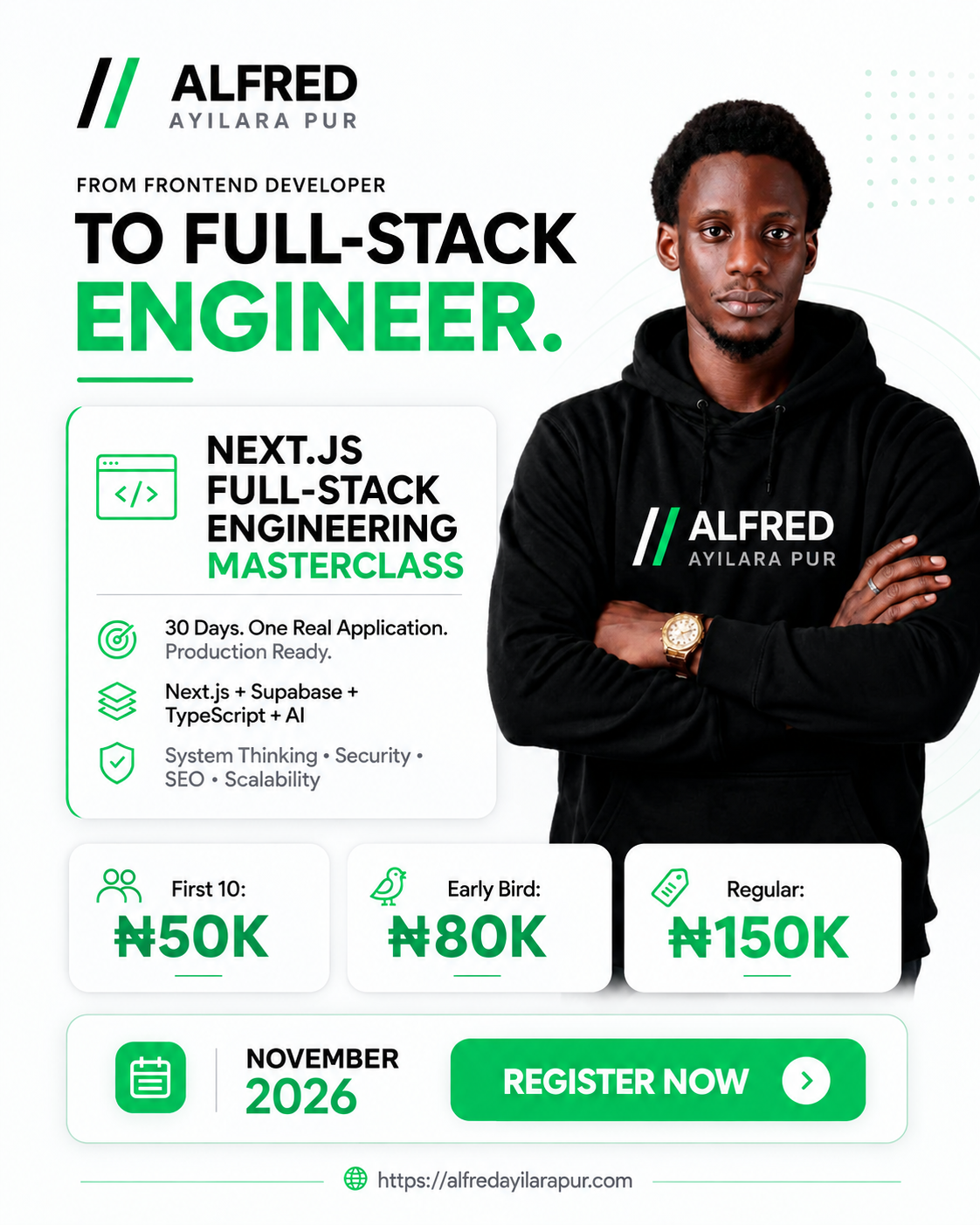
From Frontend Developer to Full-Stack Engineer in 30 Days.
Build a full-stack, multi-vendor e-commerce website with customer-facing pages, a vendor dashboard, and an admin dashboard using Next.js, while learning the engineering principles behind real-world software products.
Hands-on project
Live + Recorded Classes
Code Reviews
You can build a beautiful frontend.
You know how to create components, style pages, and make a website responsive.
But what happens when you need to build something more complex?
A platform where customers can browse products and place orders.
Where vendors can manage their products and monitor their business.
Where administrators can oversee the platform, manage users, and control operations.
Suddenly, you're no longer just building pages.
You're engineering a system.
And that's where many developers discover that knowing React or Next.js is only part of the journey.
The real challenge is understanding how different parts of an application work together:
Frontend and backend logic.
Database design and data relationships.
Authentication and authorization.
Vendor and admin roles.
Order and product management.
Application security.
Deployment and maintenance.
If you're ready to move beyond isolated tutorials and learn by building something substantial, this masterclass is designed for that journey.
Build the Kind of Application That Brings Full-Stack Engineering Together
Welcome to the Next.js Full-Stack Engineering Masterclass.
Over 30 days, you'll work on a practical e-commerce platform with multiple user roles and dashboards.
You won't just build a storefront.
You'll work toward building the systems behind it.

1. Customer E-commerce Website
Build the customer-facing experience where users can explore products and interact with the online store.
Learn how the frontend connects to the underlying application functionality.

2. Vendor Dashboard
Create a dedicated dashboard for vendors to manage their products and relevant business activities.
Explore role-specific functionality and data management.

3. Admin Dashboard
Build an administration interface for managing the platform's operations, users, products, and other defined resources.
Understand how administrative functionality fits into a multi-role application.
One project. Multiple perspectives. A broader engineering experience.
The e-commerce project gives you an opportunity to work through the challenges that arise when different parts of a software product need to function together.
You'll learn by implementing the features, understanding the underlying logic, and receiving feedback throughout the training.
Why Learn From Me?
I've trained over 400 students across the southwestern states of Nigeria to become software engineers.
My experience isn't limited to teaching programming concepts.
I've also worked with e-commerce startups and fintech startups, including experience as a backend engineer and product manager in a fintech environment that processed approximately ₦500 million in monthly transaction volume, based on my professional experience.
That exposure has helped me understand software from different perspectives:
How applications are built.
How backend systems handle business logic and data.
How products are developed around real user needs.
How engineering decisions connect to business operations.
How students can learn practical development workflows.
I've also worked on government-related projects through my training experience.
This masterclass brings those learning and engineering perspectives into a structured, hands-on environment.
My goal isn't just to show you how to write code. It's to help you understand what you're building, why you're building it, and how the different pieces of a software product fit together.
400+ Students Trained
Software engineering training across southwestern Nigeria.
Backend Engineering & Product Management
Experience across fintech and e-commerce startup environments.
Government-Related Projects
Professional exposure to software training and project delivery.
What You'll Learn Inside the Masterclass
This isn't about learning a long list of technologies without knowing how they connect.
The curriculum is structured around building the e-commerce platform while developing your understanding of modern full-stack engineering.
Module 1: Next.js & Full-Stack Application Architecture
Learn how to structure a modern Next.js application and understand the relationship between the client, server, and application logic.
You'll explore:
Next.js App Router.
React and TypeScript.
Server and client components.
Routing and layouts.
Application structure and reusable components.
Server-side functionality.
The benefit: Develop a stronger foundation for building applications that extend beyond frontend interfaces.
Module 2: Building the Customer E-commerce Website
Create the customer-facing side of the e-commerce platform.
You'll work through the development of the online shopping experience and the functionality included in the project.
You'll explore:
Product listing and detail pages.
Responsive user interfaces.
Product browsing.
Shopping experience and relevant application interactions.
Connecting frontend components to application data.
The benefit: Understand how a customer-facing e-commerce interface is developed and connected to backend functionality.
Module 3: Vendor Dashboard Development
Build the vendor-facing dashboard as part of the multi-vendor platform.
You'll explore:
Vendor-specific access and functionality.
Product management workflows.
Vendor dashboard interfaces.
Data handling and relevant business logic.
Role-specific application experiences.
The benefit: Gain practical experience building functionality for users who operate within a shared platform.
Module 4: Admin Dashboard Development
Learn how to build an administration dashboard for the e-commerce platform.
You'll explore:
Admin-specific functionality.
Platform management workflows.
User and product administration.
Relevant data management.
Connecting dashboard features to backend logic.
The benefit: Understand how administrative systems differ from customer-facing and vendor-facing experiences.
Module 5: Database Engineering & Data Relationships
An e-commerce platform needs more than attractive pages. It needs structured data and relationships between the entities that power the business.
You'll explore:
Database structure.
Product and user data.
Relationships between relevant entities.
Queries and data access.
Managing persistent application data.
The benefit: Develop a clearer understanding of how applications store, retrieve, and work with business data.
Module 6: Authentication & Authorization
A multi-role application needs to distinguish between different types of users and their permitted actions.
You'll explore:
User authentication.
Role-based access.
Protected application functionality.
Authorization considerations.
Secure handling of user access.
The benefit: Learn the foundational concepts behind creating applications with different user roles.
Module 7: Backend Development & Business Logic
Go deeper into the logic that powers your e-commerce application.
You'll explore:
Server-side functionality.
APIs and data operations.
Server Actions where applicable.
Business rules.
Error handling.
Connecting application logic to the database.
The benefit: Improve your understanding of how full-stack applications process requests and execute business functionality.
Module 8: Forms, Validation & Application Reliability
Real applications need to handle user input carefully.
You'll explore:
Form handling.
Input validation.
Error states.
Data integrity.
User feedback.
Practical debugging workflows.
The benefit: Build more reliable application interactions and understand how to handle common development challenges.
Module 9: Application Security
Security is not something to consider only after the application is built.
You'll explore relevant security principles throughout the development process.
You'll explore:
Authentication and authorization considerations.
Input validation.
Access control.
Protecting sensitive application operations.
Secure data handling practices.
The benefit: Develop better awareness of common security concerns when building full-stack applications.
Module 10: AI-Powered Features
Explore how AI can be integrated into modern web applications.
The specific AI functionality will depend on the capstone implementation and confirmed curriculum scope.
The benefit: Gain practical exposure to integrating AI capabilities into an application rather than treating AI as a separate topic.
Module 11: Testing, Debugging & Code Reviews
Writing code is only one part of engineering.
You'll receive opportunities to review your work, identify problems, and improve your implementation.
You'll explore:
Debugging workflows.
Code review practices.
Identifying implementation issues.
Code quality considerations.
Improving your development process.
The benefit: Learn to approach development with more structure and feedback.
Module 12: Deployment & Production-Oriented Workflows
Move beyond local development and explore the process of preparing and deploying your application.
You'll explore:
Deployment workflows.
Environment configuration.
Version control.
Application setup.
Production-oriented considerations.
The benefit: Develop an understanding of the steps involved in moving an application toward a live environment.
What You'll Build

A Multi-Vendor E-commerce Platform
During the masterclass, you'll work on a practical e-commerce application with three key experiences.
Customer Experience
A website for customers to interact with the e-commerce platform.
Vendor Experience
A dedicated dashboard for vendors to manage their relevant platform activities.
Admin Experience
A dashboard for administrators to manage the platform's defined operations.
Why this project matters
Building a multi-vendor e-commerce platform gives you the opportunity to work with more than one type of user and more than one application workflow.
You'll have to think about how different users interact with the same underlying system.
That's where the engineering learning becomes more practical.
This Is How You'll Learn
You won't be left alone to watch recordings and figure everything out by yourself.
The masterclass combines structured content with opportunities for interaction, feedback, and practical implementation.

Recorded Classes
Learn through recorded lessons that you can revisit as you work through the material.

Live Sessions
Participate in live learning sessions where concepts can be explained and questions addressed.

Code Reviews
Get feedback on your implementation and identify opportunities to improve your code.

Community Support
Learn alongside other participants and engage with a community during the program.

Direct Instructor Feedback
Receive guidance and feedback from me as you work through the training and project.
You get structured learning, practical building, and feedback throughout the experience.
The precise frequency of live sessions, code review limits, and support response times should be stated in the final enrollment terms.
Who Is This Masterclass For?
This masterclass is designed for developers who want to build stronger full-stack engineering skills through a substantial project.
Frontend developers who want to expand into full-stack development.
React developers who want practical experience with Next.js application architecture.
Junior software engineers who want to build a more substantial project.
Self-taught developers who want structured instruction and feedback.
Developers interested in e-commerce applications, dashboards, and multi-role systems.
Who should consider strengthening their foundations first?
If you're completely new to programming or unfamiliar with JavaScript and React, this intermediate-focused masterclass may not be the ideal starting point.
You should have enough foundational knowledge to follow the development process and work through the project.
What You'll Walk Away With
By working through the masterclass, you'll have the opportunity to develop:
A substantial e-commerce project
Work toward building a multi-vendor e-commerce platform with customer, vendor, and admin experiences.
Full-stack engineering experience
Apply concepts across frontend, backend, databases, authentication, and application workflows.
Feedback on your code
Receive code reviews and instructor feedback as part of the learning process.
A stronger understanding of application architecture
Learn how different parts of a multi-role application connect and work together.
The project is intended to support your learning and provide a potential portfolio artifact. Completion, project scope, and production-readiness depend on your implementation and the standards defined for the capstone.
Enrollment Opens for November 1st
Choose Your Enrollment Tier
I've structured the proposed pricing deadlines around your November 1, 2026 start date.
The dates below are recommended campaign deadlines, not existing commitments. Adjust them if your actual capacity, marketing schedule, or payment policy requires it.
First 10 Enrollments
Founding Offer
September 18 – October 5, 2026
For the first 10 students who secure their places.
₦50,000
Early Bird
October 6 – October 20, 2026
Early enrollment pricing before the regular tier.
₦80,000
Regular Enrollment
October 21 – October 31, 2026
Standard enrollment pricing ahead of the start date.
₦150,000
Enrollment Closes
October 31, 2026 · 11:59 PM
Recommended deadline for preparation before classes begin.
Proposed
Why these deadlines?
The tier structure creates three enrollment windows:
First 10: A limited, quantity-based introductory offer.
Early Bird: A time-limited lower price.
Regular: The standard price leading up to the program start.
Only use the first-10 limit and time deadlines if you intend to enforce them. If you want to accept late enrollment, communicate whether students can still join after October 31 and how that affects access to live sessions or the cohort.
Your Next Step Starts Here
You don't need to wait until you know every aspect of full-stack engineering before you begin learning.
You need a structured environment where you can work on a meaningful project, ask questions, receive feedback, and develop your skills through practice.
The Next.js Full-Stack Engineering Masterclass is designed to give you that experience.
From customer-facing interfaces to vendor and admin dashboards, you'll work on a project that brings multiple parts of modern application development together.
Starts November 1, 2026
Ready to Build Your Full-Stack E-commerce Application?
Join the Next.js Full-Stack Engineering Masterclass and develop practical experience building a multi-vendor e-commerce platform.
Starting from
₦50,000
Frequently Asked Questions
1. What will we build during the masterclass?
You'll work on a multi-vendor e-commerce website that includes a customer-facing experience, a vendor dashboard, and an admin dashboard.
2. Who is this course for?
The masterclass is designed for developers with foundational JavaScript and React knowledge who want to build practical full-stack engineering skills using Next.js.
3. What learning support is included?
The training features recorded classes, live sessions, code reviews, community support, and direct instructor feedback.
4. Why should I learn from you?
I've trained over 400 students across southwestern Nigeria to become software engineers. I've also worked with e-commerce and fintech startups as a backend engineer and product manager, including experience in a fintech environment processing approximately ₦500 million in monthly transaction volume.
5. When does the masterclass start?
The masterclass starts on November 1, 2026, and runs for 30 days.
6. How much does enrollment cost?
The proposed enrollment tiers are ₦50,000 for the first 10 students, ₦80,000 early bird, and ₦150,000 regular. All prices are in Nigerian naira.
7. When does enrollment close?
The recommended enrollment deadline is October 31, 2026, at 11:59 PM, ahead of the November 1 start date. Confirm whether late enrollment will be accepted.
8. Is there a refund policy?
Yes. We offer a 7-day refund window. If you decide the masterclass isn't right for you, you can request a refund during the first week of the training. Refund requests submitted after the first week are not eligible under this policy.
Curriculum
Module 1: Full-Stack Engineering Mindset: Understand how modern applications work as complete systems, from the user interface to the database and infrastructure.
Module 2: Next.js Foundations & Architecture: Master the Next.js App Router, project structure, layouts, routing, rendering strategies and application architecture.
Module 3: TypeScript for Production: Write safer, scalable and maintainable application code using TypeScript effectively.
Module 4: Building Production-Grade UIs: Build responsive, accessible and reusable interfaces with modern React and Next.js patterns.
Module 5: Backend Development with Next.js: Build server-side logic, APIs, Server Actions and application business logic without relying on a separate backend framework.
Module 6: Database Engineering with Supabase: Design database schemas, relationships, queries and data-access patterns for real-world applications.
Module 7: Authentication & Authorization: Implement secure user authentication, protected routes, roles, permissions and session management.
Module 8: Forms, Validation & Data Management: Build robust forms and reliable data flows with validation, error handling and optimistic interactions.
Module 9: AI-Powered Application Development: Integrate AI capabilities into full-stack applications and build useful AI-powered features.
Module 10: Application Security: Identify and prevent common vulnerabilities while applying practical security principles to authentication, APIs, databases and user data.
Module 11: SEO & Web Performance: Optimize Next.js applications for search engines, performance, accessibility, metadata and discoverability.
Module 12: System Design & Scalability: Learn to think beyond individual features and design applications that can handle growth, complexity and increasing users.
Module 13: Testing, Debugging & Code Quality: Develop reliable software through systematic debugging, testing strategies, error handling and maintainable code.
Module 14: Git, Deployment & Production: Take your application from local development to a live production environment with version control, deployment and environment management.
Module 15: Capstone: Build & Ship a Real Application: Apply everything you've learned to design, build, secure, deploy and present one complete production-ready application.