8 AI Trends That Will Shape 2027: The Future of Intelligent Systems, Robotics, and Computing
As 2026 draws to a close, artificial intelligence is entering its next phase. Explore eight AI trends that could define 2027, from multi-agent systems and digital labor to physical robotics, edge reasoning, and next-generation computing.
2026 is approaching its final chapter.
Artificial intelligence has spent the year evolving beyond the familiar world of chatbots, image generation, and basic automation. AI systems are becoming more capable of using tools, executing workflows, interacting with software, and supporting increasingly complex tasks.
But the next question is not simply what AI can do today.
What happens when AI systems begin working together, operating independently, interacting with the physical world, and running on increasingly diverse computing infrastructure?
As we look toward 2027, the direction of artificial intelligence points toward a broader transformation. The future will not be defined by larger models alone. It will also be shaped by autonomous systems, robotics, governance, specialized hardware, and the growing relationship between humans and machines.
Here are eight AI trends that could influence the technology landscape in 2027.
1. Multi-Agent Orchestration: The Rise of AI Teams
The first major trend is the evolution from individual AI agents to coordinated teams of specialized agents.
AI agents are systems designed to interpret objectives, plan steps, use tools, and take actions. While a single agent can handle many tasks, complex workflows often require different capabilities.
One system might be skilled at writing code. Another might specialize in research, data analysis, API interaction, or quality assurance.
Multi-agent orchestration brings these capabilities together.
How multi-agent systems work
Imagine building an e-commerce platform using a coordinated AI development team.
A planner agent breaks the project into tasks. Specialized worker agents build different components. A testing agent reviews the implementation, while a critic identifies errors and suggests improvements.
An orchestration layer coordinates the process and manages communication between the agents.
This architecture could support workflows such as:
Software development and automated testing.
Business research and report generation.
Customer support and issue resolution.
Data processing and workflow automation.
Enterprise operations and task coordination.
The potential advantage is specialization. Rather than expecting one agent to handle every part of a problem, organizations can divide work into smaller, more manageable components.
The challenge: Coordination is not the same as reliability
Multi-agent systems can introduce additional failure points.
Agents may misunderstand one another, repeat incorrect information, increase operating costs, or produce correlated errors. More agents do not automatically mean better outcomes.
For organizations adopting this approach, permissions, verification, observability, and clear task boundaries will be essential.
The 2027 opportunity: Businesses may increasingly design AI workflows as coordinated systems rather than isolated chatbot experiences.
2. Digital Labor: AI Agents That Execute Real Work
AI is moving from generating information toward performing actions.
This is the foundation of digital labor: software-based agents that can interpret tasks, follow workflows, interact with business applications, and complete defined operations.
Unlike a traditional chatbot that responds to a question, a digital worker is designed to accomplish an objective through a sequence of actions.
From prompts to business workflows
Consider a finance department receiving an invoice.
A digital agent could potentially:
Read and interpret the invoice.
Extract relevant information.
Compare the invoice with purchase records.
Identify discrepancies.
Submit the information for approval.
Update an authorized business system.
The example depends on suitable integrations, permissions, and human review. It is not a guarantee that an agent can safely execute every step without supervision.
Human oversight remains essential
As AI agents gain the ability to perform actions, businesses need to establish clear boundaries.
Which tasks can an agent execute independently? When should a human approve an action? What happens when the system encounters unexpected information?
Human-in-the-loop workflows can provide oversight, correction, and escalation when necessary.
The goal is not merely to automate more tasks. It is to create systems that extend human productivity without sacrificing accountability.
What this means for professionals
Workers may increasingly collaborate with AI systems that handle repetitive digital operations while humans focus on judgment, relationships, problem-solving, and strategic decisions.
The impact will vary significantly across industries and occupations. AI adoption will depend on cost, reliability, organizational readiness, and the nature of the work.
The 2027 opportunity: Businesses that understand how to integrate AI agents into real workflows may gain advantages in operational efficiency and service delivery.
3. Physical AI: When Machines Learn to Operate in the Real World
For years, much of the AI revolution has happened inside digital environments.
Models process text, generate images, analyze information, and write code. Physical AI expands the scope by enabling systems to perceive and interact with the real world.
This includes robotics, autonomous machines, and models designed to understand physical environments.
Beyond programmed instructions
Traditional robotic systems often depend on carefully defined rules and control mechanisms.
Physical AI introduces models that can learn patterns from data, simulations, and real-world interactions.
A robot may need to understand how to grasp an object, navigate around obstacles, or adapt to changes in its environment.
These tasks are considerably more complex than generating a text response because the system must account for physical constraints and consequences.
The role of world models
World models are designed to represent aspects of an environment and predict how it may change.
In robotics, they can support planning and simulation by helping models learn about object movement, spatial relationships, and potential outcomes.
Training in simulation can reduce the need to expose hardware to every possible scenario, although simulated environments cannot perfectly reproduce the real world.
Will humanoid robots become mainstream in 2027?
The robotics industry is working toward more capable machines that can perform useful tasks in commercial environments.
Recent reporting describes ongoing efforts to improve robot intelligence, with some industry leaders anticipating limited industrial deployments and advances in general-purpose task execution. However, significant challenges remain in reliability, dexterity, safety, and operating in unpredictable environments.
Household robotics, in particular, presents different challenges from controlled industrial settings.
Why physical AI matters
Potential applications include:
Manufacturing and industrial automation.
Warehousing and logistics.
Agriculture.
Healthcare assistance.
Inspection and maintenance.
Research and laboratory automation.
The commercial value of physical AI will depend on whether robots can perform tasks safely, reliably, and economically.
The 2027 opportunity: AI development may increasingly focus on connecting intelligent software with machines that can act in physical environments.
4. Social Computing: Humans and AI Agents Working Together
What happens when humans and AI agents operate within the same interconnected environment?
Social computing explores how people, intelligent agents, and digital systems can exchange information, coordinate actions, and respond to shared context.
The idea extends beyond using an AI assistant in isolation. It imagines a network where multiple participants contribute to a common workflow.
A shared AI environment
Consider a product team preparing to launch a new application.
A human product manager defines the objective. A research agent gathers user insights. A design agent proposes interface concepts. An engineering agent helps implement features, while a testing agent evaluates the result.
The human team can review outputs, adjust priorities, and provide decisions throughout the process.
For this to work effectively, the system needs reliable context sharing and clear responsibilities.
Collective intelligence and distributed collaboration
Collective intelligence describes how groups can produce knowledge or solve problems through collaboration.
AI agents could contribute to this model by processing information, proposing actions, and supporting coordination among human participants.
However, the emergence of useful collective behavior is not automatic. Poor communication, conflicting instructions, and unreliable information can undermine the system.
The technical challenge is to develop shared environments where agents can exchange context without compromising privacy, security, or control.
What could change in 2027?
We may see more collaborative interfaces in which users delegate subtasks to multiple AI systems and review their progress through a shared workspace.
The experience could resemble managing a digital team rather than interacting with a single assistant.
The 2027 opportunity: The interface between humans and AI may become more collaborative, with systems designed around shared context and coordinated work.
5. Verifiable AI: Trust, Transparency, and Governance
As artificial intelligence becomes more deeply embedded in business operations, trust and accountability become increasingly important.
AI systems may process sensitive information, influence decisions, and execute actions that affect customers or organizations.
This creates a need for verifiable AI: systems and processes that support transparency, auditing, traceability, and accountability.
What makes AI verifiable?
Several capabilities are relevant.
Documentation and evaluation
Organizations need to understand how AI systems are developed, tested, and monitored.
For higher-risk applications, technical documentation and risk assessments may be required under applicable regulations.
Transparency
Users should receive appropriate information about AI interactions and generated content where disclosure obligations apply.
Transparency helps people understand when they are interacting with an automated system.
Data lineage
Organizations should be able to track relevant information about data sources, processing, and usage.
Data lineage can support compliance, troubleshooting, and responsible data management.
Monitoring and auditability
An AI system should ideally produce records that help organizations investigate decisions, failures, and significant actions.
The specific requirements depend on the system and regulatory environment.
AI governance is becoming an engineering concern
Governance is not only a legal or administrative responsibility.
Developers and technical teams may need to implement access controls, logging, evaluation frameworks, monitoring systems, and safeguards directly into AI products.
This is particularly important when agents can access external tools, enterprise databases, or operational systems.
Why 2027 matters
As AI adoption expands, businesses may face greater pressure to demonstrate that their systems are controlled, tested, and used responsibly.
Organizations that build governance into their development process can be better positioned to manage operational and compliance risks.
The 2027 opportunity: AI products will increasingly need to demonstrate not only what they can do, but also how their actions can be understood and governed.
6. Quantum Computing: Moving Toward Practical Hybrid Applications
Quantum computing remains one of the most closely watched areas of advanced computing.
Unlike classical computers, quantum computers use quantum-mechanical properties to process information in ways that may provide advantages for particular problems.
The important question moving toward 2027 is whether quantum systems can demonstrate useful benefits in real-world applications.
What is quantum utility?
Quantum utility refers to achieving useful computational outcomes with quantum systems for specific applications.
Potential areas of research include:
Optimization.
Molecular and materials simulation.
Certain scientific computing workloads.
Specialized computational problems.
These are not problems that classical computers universally fail to solve. The potential value of quantum computing lies in whether particular quantum algorithms can offer a meaningful advantage for suitable tasks.
Hybrid quantum-classical computing
Quantum computers are expected to operate alongside classical infrastructure in many proposed architectures.
A classical system may manage the workflow, prepare data, and process results, while a quantum processor handles a specialized computational component.
This hybrid approach acknowledges the strengths and limitations of both computing paradigms.
The challenges ahead
Practical quantum computing faces challenges involving hardware quality, error correction, algorithm development, scalability, and cost.
Progress in research does not necessarily translate immediately into commercial advantage.
Organizations exploring quantum technologies should focus on specific use cases and demonstrated performance rather than assuming quantum computing will replace classical systems.
The 2027 opportunity: Continued advances in quantum hardware and algorithms could create new opportunities for research and specialized computational workloads, although the timing and scale of commercial impact remain uncertain.
7. Reasoning at the Edge: Smaller Models, Local Intelligence
AI is not only becoming more capable. It is also becoming more distributed.
Cloud computing remains important for large-scale model training and inference, but smaller AI models can operate on laptops, smartphones, embedded devices, and other edge hardware.
The next stage involves improving the reasoning capabilities of these compact models.
What is edge AI?
Edge AI refers to processing AI workloads close to where data is generated or used.
Instead of sending every request to a remote data center, an application may execute some or all of its AI processing locally.
This can be useful for applications that require low latency, limited connectivity, or tighter control over sensitive information.
The growth of small reasoning models
Modern AI systems may allocate additional computation during inference to work through complex problems.
One research direction is transferring useful reasoning capabilities from larger models into smaller ones through methods such as distillation and other training techniques.
The goal is to make more capable models available on hardware with limited memory and computational resources.
Why local reasoning matters
Local AI can offer several potential benefits:
Reduced latency: Applications may avoid some network round trips.
Privacy: Data can remain on a device in applications designed for local processing.
Offline access: Certain features may continue working without an internet connection.
Lower connectivity dependence: Devices can process tasks in environments with unreliable network access.
These benefits depend on model quality, device capability, energy consumption, and application design.
Implications for Africa and emerging markets
Edge AI could be relevant in environments where connectivity, bandwidth, or cloud costs create operational constraints.
Potential applications include local-language assistants, offline educational tools, agricultural technologies, and intelligent devices.
However, real-world adoption requires affordable hardware, suitable models, and reliable deployment infrastructure.
The 2027 opportunity: More capable local models could expand the range of AI applications that function directly on user devices.
8. Hybrid Computing: The Convergence of AI Architectures and Specialized Hardware
The final trend is the development of increasingly heterogeneous computing systems.
AI workloads are not identical. Different models and tasks may have different requirements for memory, processing speed, latency, and energy efficiency.
This creates demand for computing environments that combine multiple architectures and processor types.
Beyond a single AI architecture
Transformers have played a major role in modern AI development.
At the same time, researchers are exploring alternative architectures, including state space models and hybrid approaches that combine different computational mechanisms.
Different architectures may offer advantages for particular tasks. Their effectiveness depends on the specific workload, implementation, and hardware environment.
The future of AI may involve a broader range of model designs rather than a single architecture dominating every application.
The rise of specialized computing
Modern computing infrastructure already uses different processor types.
These can include:
CPUs: General-purpose computing.
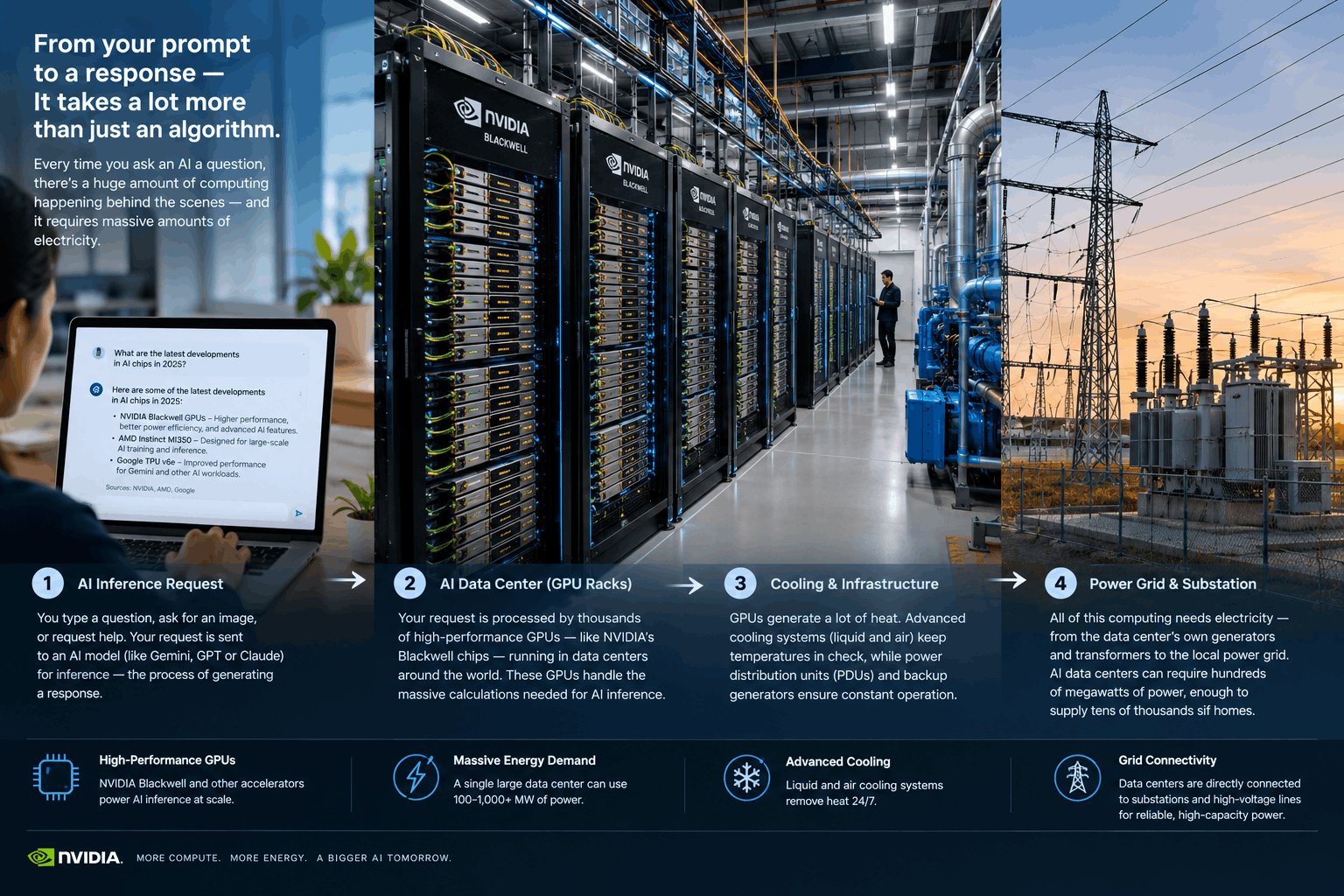
GPUs: Parallel processing and AI acceleration.
TPUs: Specialized machine learning processing.
QPUs: Quantum processing units.
Neuromorphic chips: Hardware inspired by aspects of biological neural systems.
Each technology has different capabilities and constraints.
Intelligent workload allocation
One potential direction is automatically assigning different parts of a workload to the computing resources most suitable for them.
For example, a system could use a GPU for one processing task, a CPU for another, and specialized hardware where it provides a demonstrated advantage.
This requires sophisticated orchestration software, hardware compatibility, resource management, and performance monitoring.
Why this matters for the future
As AI applications become more complex, infrastructure decisions will influence performance, cost, and scalability.
Businesses may need to consider more than simply selecting an AI model. They will also need to determine where and how that model should run.
The 2027 opportunity: AI infrastructure could become more flexible, with multiple model architectures and processing technologies working together to support different workloads.
What These AI Trends Mean for Developers and Businesses in 2027
The eight trends above share a common theme.
AI is expanding from individual applications into interconnected systems that can perform tasks, collaborate with people, and interact with the physical and computational environments around them.
For developers and business leaders, this shift creates several practical considerations.
1. Learn to build AI-powered workflows
Understanding how to integrate AI into real business processes may become increasingly valuable.
Developers should explore:
Agent orchestration.
API integration.
Workflow automation.
AI evaluation.
Security and permissions.
Human approval mechanisms.
The goal is to build reliable systems rather than simply adding an AI feature to an application.
2. Treat AI infrastructure as a strategic decision
Cloud, edge, and hybrid deployments have different trade-offs.
Teams should evaluate latency, cost, privacy, hardware availability, and reliability before choosing a deployment architecture.
3. Build governance into the product
AI systems should be designed with appropriate controls from the beginning.
This includes access management, data handling, monitoring, testing, and incident response.
The requirements will differ depending on the application's risk and jurisdiction.
4. Develop skills beyond prompt engineering
AI engineering increasingly intersects with multiple disciplines.
Developers may benefit from learning:
Software architecture.
Machine learning fundamentals.
Distributed systems.
Cloud and edge infrastructure.
Data engineering.
AI security.
Product management and evaluation.
The most useful skills will depend on the problems being solved and the systems being built.
Final Thoughts: 2027 May Be About How AI Works, Not Just What It Generates
The next phase of artificial intelligence is likely to be defined by more than increasingly powerful models.
It will involve the systems built around those models: agents that coordinate tasks, digital workers that execute workflows, robots that interact with physical environments, and infrastructure that supports different forms of computation.
Verifiable AI highlights the importance of trust and accountability. Edge reasoning explores local intelligence, while quantum computing and hybrid architectures point toward alternative approaches to computational workloads.
Some of these developments may progress rapidly. Others may take longer than expected or face technical and economic limitations.
The most important question for businesses and developers is not whether every prediction will come true.
It is whether they are prepared to understand the technologies, evaluate their practical value, and build responsibly as the landscape evolves.
The future of AI will not be shaped by models alone. It will be shaped by the systems, people, and infrastructure that put those models to work.
Which AI trend do you expect to have the greatest impact on technology and business in 2027? Share your thoughts in the comments.